
Whale Watching in the Azores: Why This Hidden Atlantic Adventure Belongs on Your Bucket List
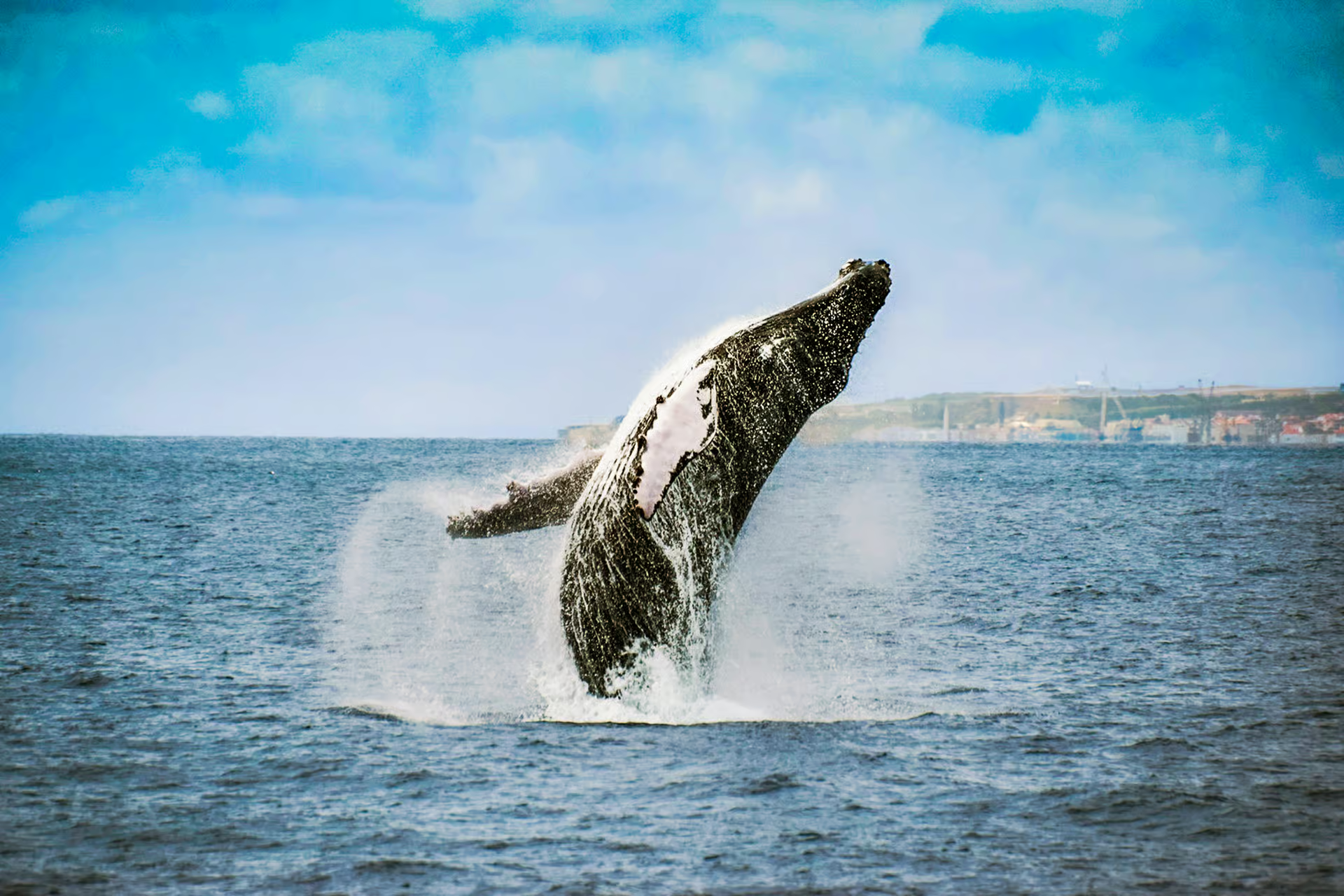
Table of Contents
I still remember the exact moment.
We were three hours into the Atlantic, engines cut, floating in complete silence. Our marine biologist guide raised her hand—the universal signal for “something’s happening.” Then, 50 meters from our boat, the ocean exploded.
A sperm whale breached, its massive body launching from the water in slow motion. Twenty tons of pure power suspended in mid-air before crashing back down, sending waves rippling across the glassy Atlantic.
Everyone on our small boat stood frozen, cameras forgotten, just… watching.
That’s when I understood why the Azores might be the world’s best-kept secret for whale watching. And why, if you’re building your bucket list of once-in-a-lifetime adventures, this experience needs to be near the top.
Why the Azores (And Why Nobody’s Talking About It)
The Azores—nine volcanic islands scattered 1,000 miles off Portugal’s coast in the middle of the Atlantic Ocean—sit at one of the planet’s most remarkable marine crossroads.
Here’s what makes this place extraordinary:
28 of the world’s 81 whale and dolphin species pass through or live in Azorean waters year-round. That’s more than a third of all known cetacean species on Earth, concentrated in one small archipelago.
For context: that’s more diversity than Iceland, Norway, or California’s famous whale watching coasts.
But unlike those destinations, the Azores remain gloriously under the radar. While Reykjavik’s whale watching boats pack 200 tourists per trip, Azores operations keep groups small, personal, and intimate. The entire archipelago receives fewer annual tourists than tiny Hallstatt, Austria gets in a single month.
Translation: You get world-class whale watching without the crowds, without the performance, and without the Instagram chaos that’s ruined so many natural experiences.
The Azores are what Iceland was 20 years ago, before everyone discovered it.
The Wildlife You’ll Actually See (98% Success Rate)
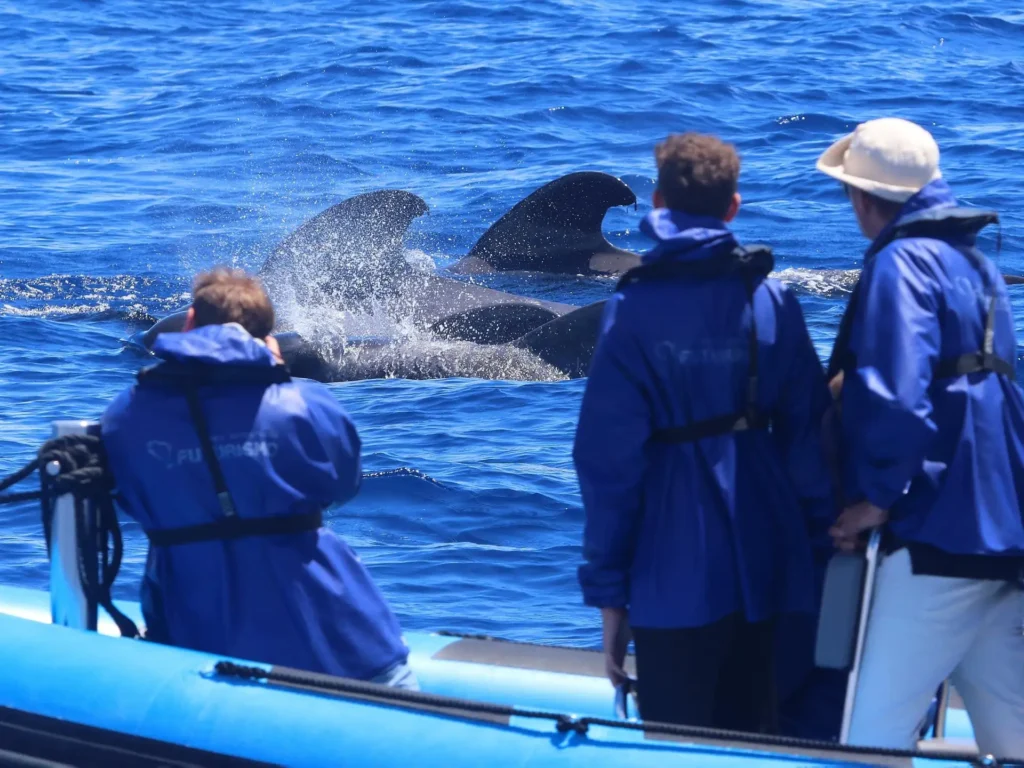
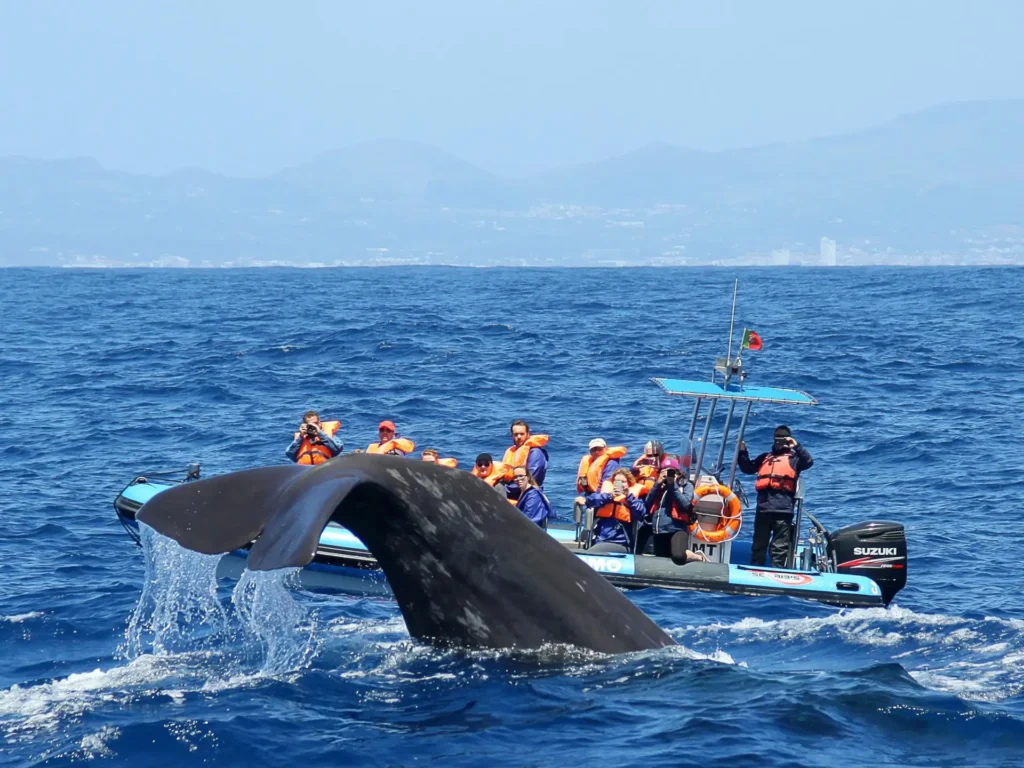
Let’s talk specifics, because “whale watching” means different things in different places.
Year-Round Residents (The Guarantees)
Sperm Whales – The giants that made Herman Melville write Moby Dick. These deep-diving titans can reach 60 feet long and dive over 3,000 feet deep hunting giant squid. They’re the Azores’ emblematic species and can be seen any month of the year, though summer months offer higher chances.
Male sperm whales are solitary, while females travel in family groups with their calves. Watching a mother and calf surface together, synchronized breaths echoing across the water, ranks among nature’s most moving moments.
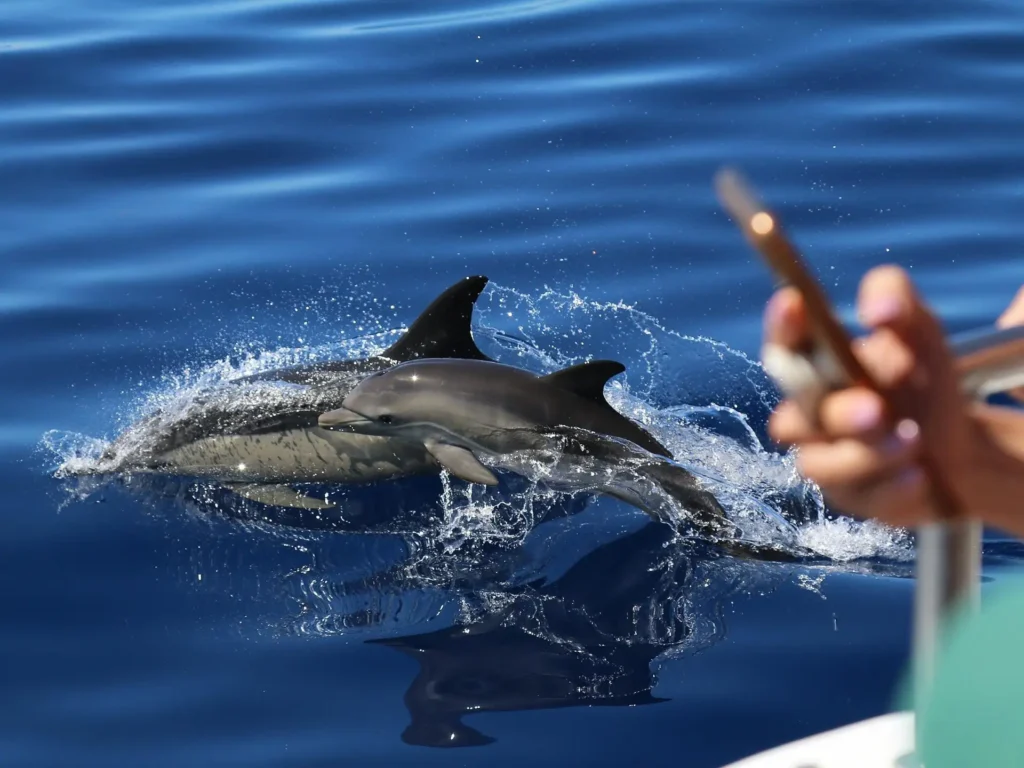
Common Dolphins – Playful, acrobatic, and often travel in huge pods. Seeing 200+ dolphins bow-riding alongside your boat, leaping and spinning, never gets old. These aren’t captive dolphins doing tricks—they’re choosing to interact, purely for the joy of it.
Bottlenose Dolphins – The intelligent, curious species you recognize from documentaries. Bottlenose dolphins in the Azores are notably interactive, sometimes approaching boats to investigate the strange land mammals staring at them.
Risso’s Dolphins – Heavily scarred from squid battles and social interactions, these dolphins look ancient and battle-worn. Their gray bodies covered in white scratches tell stories of deep ocean hunts.
Spring Migration (March-June): The Giants Arrive
This is when whale watching in the Azores becomes truly legendary.
Blue Whales – The largest animals ever to exist on Earth. Adults can reach 100 feet and weigh up to 200 tons. Their hearts alone are the size of a small car. Seeing one surface is like watching a submarine breach—except it’s alive, breathing, and utterly magnificent.
Blue whales migrate through the Azores from mid-March through early June, feeding on the massive plankton blooms that occur during this season before continuing north to Arctic feeding grounds.
Fin Whales – The second-largest whale species, sleek and fast. Known as the “greyhounds of the sea,” fin whales can reach 85 feet and swim at speeds up to 25 mph. Their distinctive asymmetrical jaw (white on the right side, dark on the left) makes them unmistakable.
Sei Whales – Slightly smaller at 60 feet but no less impressive. Sei whales are graceful, surface-feeding whales that arrive in the Azores from April through June, often seen feeding in groups.
April and May represent peak season for seeing multiple giant whale species on a single trip. The ocean becomes a highway of migrating cetaceans, all passing through nutrient-rich Azorean waters to feed before their long journey to Arctic summer grounds.
Summer Visitors (June-September)
As water temperatures rise, different species arrive:
Atlantic Spotted Dolphins – Only seen in summer months, these dolphins feature distinctive spotted patterns that develop as they age. Young ones are born plain gray, earning more spots with each year.
Striped Dolphins – Named for distinctive blue-white stripes along their sides, striped dolphins are smaller and incredibly fast, known for spectacular aerial displays.
Pilot Whales – Actually large dolphins despite the name. Pilot whales travel in tight-knit family groups and occasionally strand themselves on beaches following sick leaders—a heartbreaking testament to their deep social bonds.
The Unexpected Encounters
Beyond the regular cast, Azores whale watching delivers surprise guests:
- Humpback Whales (spring and occasionally autumn)
- Minke Whales (spring)
- Hammerhead Sharks (yes, seriously—one of our fellow passengers spotted one)
- Sea Turtles (loggerheads are common)
- Manta Rays (gliding through plankton blooms)
- Ocean Sunfish (bizarre prehistoric-looking creatures)
- Cory’s Shearwaters (abundant seabirds with distinctive calls)
The marine biologists on board can identify species from miles away—a distant spout’s shape, height, and rhythm tells them exactly which whale they’re tracking.
Success rate across all Azores operators: 98%.
That means on 98 out of 100 trips, you WILL see cetaceans. Many operators guarantee a second free trip if you don’t spot any marine mammals—though you’ll almost certainly need that guarantee.
How Whale Watching Actually Works in the Azores
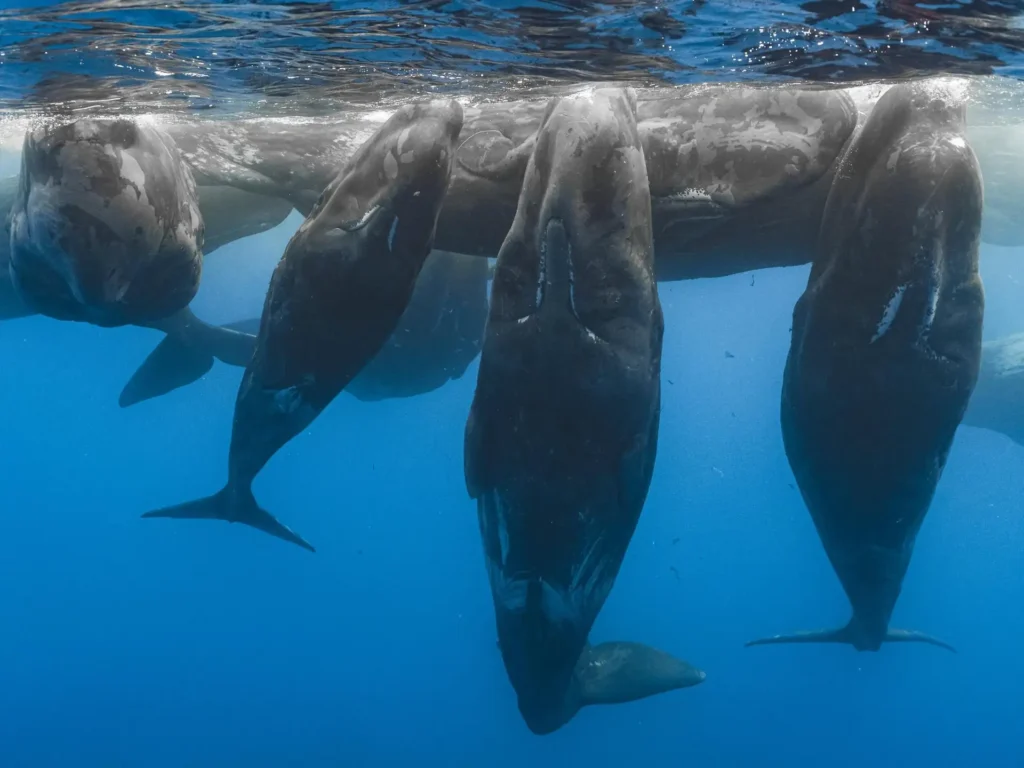
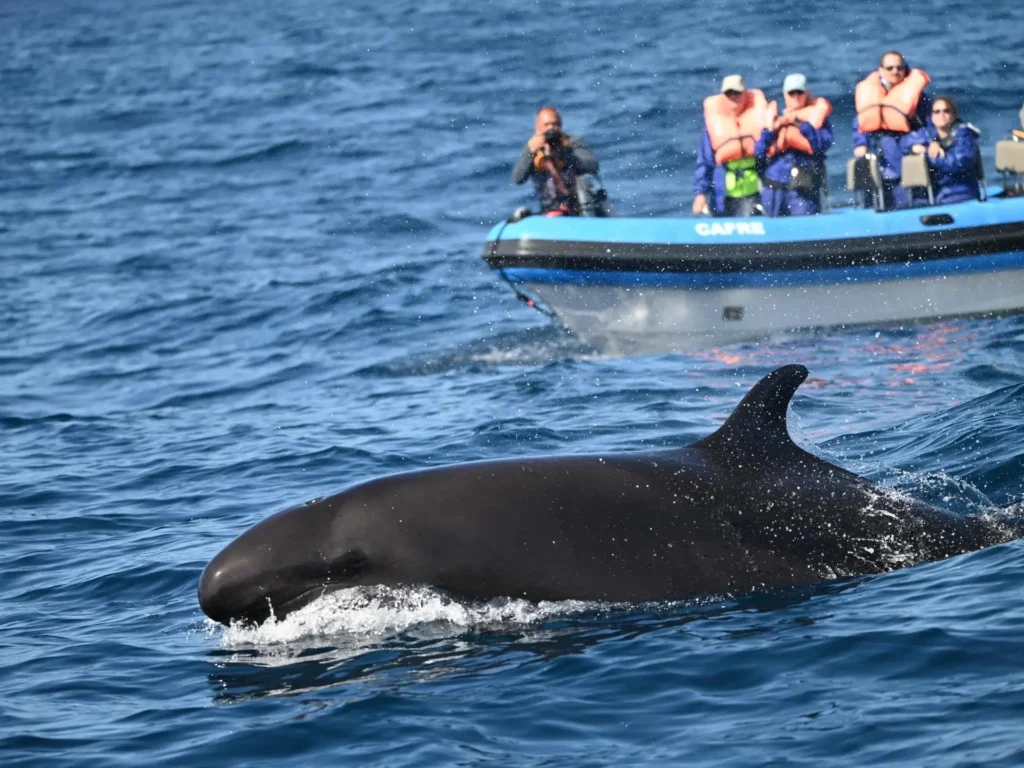
This isn’t a passive cruise where you scan empty horizons hoping for luck.
The Azores pioneered a whale watching system that’s both incredibly effective and deeply rooted in the islands’ whaling history.
The Vigias: Land-Based Spotters
Scattered along coastal cliffs throughout the Azores, you’ll notice small stone structures with windows facing the ocean. These are vigias—whale observation posts originally built for whaling operations.
Today, skilled spotters sit in these vigias during tour hours, scanning the horizon with binoculars. When they spot whale spouts or dolphin pods, they radio exact coordinates to boats at sea.
This system dramatically increases success rates. Rather than boats aimlessly searching the Atlantic, they receive real-time intelligence: “Sperm whale pod, 12 nautical miles northeast, heading south.”
It’s whale watching informed by centuries of local knowledge and modern conservation ethics.
The Boats: Zodiac vs. Catamaran
Azores operators typically offer two vessel types:
Zodiac (Rigid Inflatable Boats):
- Fast, agile, can get closer to wildlife
- More adventurous, exciting experience
- You WILL get wet from sea spray
- Not recommended for: young children (under 6), pregnant women, back/neck problems, anyone prone to seasickness
Catamarans:
- Stable, comfortable, has restrooms
- Better for families, elderly, anyone with mobility concerns
- Smoother ride, less water spray
- Slower, can’t maneuver as quickly
Both options provide excellent wildlife viewing. Choose based on your adventure tolerance and physical needs.
The Marine Biologists
Every reputable Azores whale watching tour includes a marine biologist or naturalist guide.
These aren’t tour guides reading from scripts. They’re actual researchers who study Azorean cetaceans, often contributing data to long-term monitoring projects like MONICET (a voluntary research organization tracking cetacean populations across the archipelago).
Your trip directly supports ongoing marine research. The data collected—species identified, behaviors observed, photo IDs taken—contributes to understanding migration patterns, population health, and conservation needs.
You’re not just a tourist. You’re a citizen scientist participating in active research.
The biologists explain:
- How to identify species from their blows (sperm whales have distinctive forward-angled spouts)
- Why sperm whales dive for 45+ minutes (hunting giant squid in the deep ocean)
- How dolphins use echolocation to hunt
- The difference between resident and migratory populations
- Current conservation challenges facing different species
It transforms whale watching from “Oooh, look!” into genuine education and appreciation.
The Experience: What Three Hours on the Atlantic Feels Like
Hour 1: Anticipation
You depart from harbor, usually Ponta Delgada on São Miguel Island. The captain receives coordinates from vigia spotters. Engines roar as you head toward open ocean.
The marine biologist provides briefing: safety procedures, what to look for, how to behave around wildlife, respect guidelines.
Everyone’s scanning horizons, cameras ready.
Hour 2: The Search
Sometimes you spot whales within 15 minutes. Sometimes it takes longer.
The boat slows. Engines cut. Silence.
You’re floating in the middle of the Atlantic Ocean, surrounded by nothing but water and sky. The quiet is profound.
Then—a spout. A puff of vapor on the horizon.
Engines restart. You close the distance slowly, carefully, following strict observation protocols (no closer than 50 meters, 100 meters if calves present).
Hour 3: The Encounter
The whale surfaces. Everyone holds their breath.
It’s massive. So much larger than you imagined, even knowing the facts intellectually.
It breathes—a deep, echoing exhale that sounds ancient and alive and impossibly powerful.
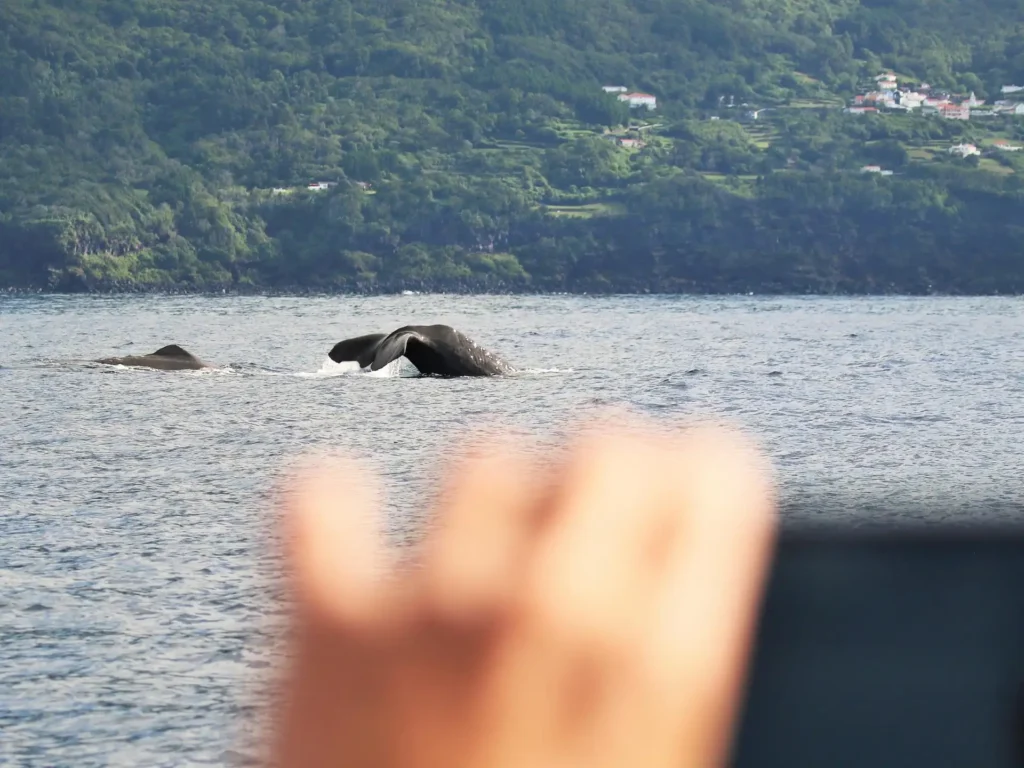
Then it dives. The tail flukes lift high, water streaming off those massive fins. A moment suspended. Then they slip beneath the surface without a splash, leaving only ripples.
You realize you forgot to take photos. You were too busy living the moment.
This is why whale watching belongs on your bucket list.
Not because you need another Instagram post. Because witnessing wild animals this magnificent, this close, in their natural habitat, reminds you that the world is bigger than your daily concerns, and that some experiences transcend photography.
When to Go: Seasonal Guide to Azores Whale Watching
While whales can be spotted year-round thanks to resident species, timing matters if you want to see specific animals.
Spring (March-June): BEST TIME FOR GIANTS
Peak months: April and May
This is the season for serious whale watchers. The massive baleen whales—blue whales, fin whales, sei whales—migrate through Azorean waters during these months.
Why? Plankton blooms.
As spring arrives, nutrient-rich waters triggered by seasonal upwelling create massive plankton blooms. These microscopic organisms feed krill, which feeds whales.
The giant baleen whales are traveling from winter breeding grounds near the equator to summer feeding areas off Greenland, Iceland, and Norway. The Azores represent a critical stopover where they can feed heavily before continuing north.
What you might see:
- Blue whales (March-June, peak April-May)
- Fin whales (April-June)
- Sei whales (April-June)
- Sperm whales (year-round, always present)
- All resident dolphin species
- Sea turtles
- Possibly humpback whales
Weather: Pleasant spring temperatures, generally calmer seas than winter, occasional rain
Crowds: Moderate. April-May attracts serious whale watchers but isn’t overwhelmed
Verdict: Absolute best time if you want to see the ocean’s giants
Summer (June-September): WARM WATERS, DIFFERENT SPECIES
Peak months: July-August
Summer brings warmth, calm seas, and different cetacean species drawn to warmer waters.
What you might see:
- Sperm whales (more abundant than other seasons)
- Atlantic spotted dolphins (summer only)
- Striped dolphins (summer specialty)
- Pilot whales (arrive in summer)
- Common, bottlenose, and Risso’s dolphins
- Many dolphin calves (breeding season)
- Potentially blue whales (can be seen through mid-June)
Summer is the best season for seeing dolphins in large numbers with babies. Watching hundreds of dolphins traveling with their calves, the young ones learning to hunt and socialize, offers a different kind of magic than giant whale encounters.
Weather: Warmest months (averaging 25°C/77°F in August), calmest seas, longest days
Crowds: Highest tourist season, but still manageable compared to other European destinations
Verdict: Best for families, first-timers, anyone prioritizing comfort and calm seas
Autumn (September-November): REVERSE MIGRATION
Peak months: September-October
Autumn brings reverse migration as some species head south for winter. Historically, October has been excellent for humpback whale sightings as they pass through the Azores.
What you might see:
- Humpback whales (October especially)
- Sperm whales (still abundant)
- Resident dolphin species
- Occasional fin whales
- Late-season spotted and striped dolphins
Weather: Still pleasant, but less predictable. September can be lovely; November brings more rain and wind
Crowds: Significantly fewer than summer
Verdict: Good for avoiding crowds while maintaining decent whale-watching opportunities
Winter (December-February): OFF-SEASON ADVENTURES
Peak months: None—this is genuinely off-season
What you might see:
- Sperm whales (year-round residents)
- Common dolphins
- Bottlenose dolphins
- Risso’s dolphins
Weather: Rougher seas, more rain, cooler temperatures (still mild by European standards, averaging 16°C/61°F)
Crowds: Minimal
Verdict: For hardy travelers who don’t mind weather uncertainty and want to see resident species in peaceful conditions
Bottom line: If you want the iconic blue whale, fin whale, and sei whale encounters, visit April-May. If you prioritize dolphins, calm seas, and family-friendly conditions, choose summer.
Where to Whale Watch in the Azores
While all nine Azores islands offer whale-watching opportunities, three stand out:
São Miguel: Most Accessible
The largest Azores island and main entry point for most visitors. Ponta Delgada, the capital, hosts numerous whale-watching operators with daily departures.
Advantages:
- Most tour operators and departure times
- Easiest logistics (direct flights from mainland Portugal, North America, Europe)
- Combine whale watching with other São Miguel attractions
Consider: Booking a whale and dolphin watching trip from Ponta Delgada for your first Azores whale-watching experience
Pico Island: The Whaling History Island
Pico has deep connections to cetaceans. The island’s Whalers’ Museum chronicles the transition from hunting whales to protecting them—a fascinating cultural shift that happened in the 1980s when whaling was banned.
Many current whale-watching guides are former whalers or descendants of whaling families. Their knowledge of whale behavior, passed down through generations, is unmatched.
Faial Island: The Triangle Hub
Faial, particularly the town of Horta, serves as a base for exploring the “triangle islands” (Pico, Faial, São Jorge). Short ferries connect them, allowing multi-island experiences.
The Conservation Story (Why This Matters)
The Azores’ whale-watching industry exists because of a remarkable transformation.
Until the 1980s, the Azores were a whaling hub. Sperm whales, in particular, were hunted extensively. Men in small boats would harpoon whales by hand—dangerous, brutal work that defined island culture and economy for generations.
When Portugal banned whaling in 1987, many feared economic collapse.
Instead, visionary leaders like Serge Viallelle (a French emigrant to Pico Island) saw a different future. The same skills that made Azoreans excellent whalers—understanding whale behavior, reading the ocean, spotting cetaceans from miles away—could be redirected toward conservation and tourism.
The vigias that once directed hunting boats now guide whale-watching vessels.
The men who harpooned whales now protect them, teaching tourists to respect these magnificent animals while earning sustainable livelihoods.
This transition saved the whales AND the island economy.
Today, Azorean whale watching is strictly regulated:
- Minimum distance requirements (50 meters, 100 meters with calves)
- No chasing or harassing wildlife
- Limited number of boats per whale group
- Speed limits and approach protocols
- Zero tolerance for feeding or touching animals
Your tourism dollars directly fund:
- Marine research through organizations like MONICET
- Conservation education programs
- Sustainable livelihoods for former whaling communities
- Ongoing monitoring of cetacean populations
You’re not just seeing whales. You’re supporting their protection.
What Nobody Tells You (The Honest Reality)
Let’s address what typical whale-watching guides skip:
You Might Get Seasick
The Atlantic Ocean isn’t a calm lake. Even on “good” days, there’s swell.
Zodiac boats bounce. A lot. Three hours of bouncing on waves can trigger seasickness in people who’ve never experienced it before.
Strategies:
- Take seasickness medication 30-60 minutes before departure (Dramamine, Bonine, or natural ginger capsules)
- Eat a light meal beforehand (empty stomach = worse nausea; full stomach = worse if you vomit)
- Focus on the horizon, not the deck
- Stay in open air (avoid enclosed spaces)
- Choose catamaran over zodiac if you’re prone to motion sickness
Weather Can Cancel Your Trip
Atlantic weather changes rapidly. Tours get cancelled for:
- High winds
- Large swells
- Poor visibility
- Storms
This happens. Operators prioritize safety over tourist schedules.
Solution: Build flexibility into your Azores itinerary. Don’t book whale watching for your only day on São Miguel. Give yourself 3-4 days so you can reschedule if needed.
Wildlife is Wild (Duh, But Still)
Despite 98% success rates, sometimes you see fewer animals than hoped. Or you see common dolphins but not the blue whale you dreamed about.
Whales don’t perform on schedule.
Manage expectations: You’re privileged to observe wild animals in their natural habitat. What you see is what nature provides that day. Embrace uncertainty as part of the adventure.
You Need Warm Layers (Even in Summer)
Ocean temperatures and air temperatures are different things.
Even on warm sunny days, ocean wind creates chill. Sea spray is cold. You’ll be stationary on a boat for hours.
Pack:
- Windproof jacket
- Warm fleece or sweater
- Long pants (shorts = cold legs)
- Closed-toe shoes with grip (decks get wet and slippery)
- Hat and sunglasses
- Sunscreen (ocean reflection intensifies UV exposure)
Cameras Often Fail to Capture It
Phone cameras aren’t designed for photographing distant, moving whales from bouncing boats.
You’ll get blurry shots of ocean with maybe a tiny spout in the distance.
Decision: Bring a good camera if photography matters to you. Or just bring a phone and commit to being fully present rather than obsessing over getting “the shot.”
Most people who try to photograph everything remember the trip less vividly than those who simply watched.
How to Book Your Azores Whale Watching Adventure
Ready to add this to your bucket list?
Choosing an Operator
Prioritize operators who:
- Include marine biologist guides (not just boat drivers)
- Follow strict observation protocols
- Contribute to research organizations like MONICET
- Offer rescheduling or guarantees if no animals spotted
- Maintain small group sizes
- Have excellent safety records
Book a whale and dolphin watching experience with reputable operators who meet these standards.
What’s Included
Most whale-watching tours include:
- Safety briefing (15-20 minutes)
- 2.5-3 hours on the water
- Marine biologist guide
- Life jackets (mandatory on zodiacs)
- Raincoats and pants (zodiac boats)
Not typically included:
- Hotel pickup/drop-off (meet at harbor)
- Food and drinks (bring your own water and snacks)
- Underwater photography (you stay on the boat, not in the water)
Best Time to Book
For April-May trips (blue whale season): Book 2-3 months ahead. This is peak season for serious whale watchers.
For summer trips: Book 4-6 weeks ahead to ensure availability
For off-season: 1-2 weeks ahead usually sufficient
Boat Choice Strategy
Choose Zodiac if:
- You’re fit and healthy
- You don’t get seasick
- You want adventure and excitement
- You’re okay getting wet
- No back/neck issues
Choose Catamaran if:
- You’re traveling with young children (under 8)
- You’re elderly or have mobility limitations
- You’re pregnant
- You have any back/neck problems
- You prioritize comfort over adventure
- You need restroom access
Both options see the same whales. The difference is comfort vs. excitement.
Beyond Whale Watching: Making It a Full Experience
Whale watching is spectacular, but the Azores offer so much more for bucket list adventurers:
Combine with:
- Volcanic hot springs (Furnas on São Miguel)
- Crater lake kayaking (Sete Cidades)
- Volcanic cave exploration
- Coastal hiking trails
- Swimming in natural ocean pools
- Diving and snorkeling
- Wine tasting (Pico Island’s volcanic vineyards)
- Canyoning adventures
Consider spending 5-7 days on São Miguel to experience whale watching plus the island’s other incredible offerings.
Or design a multi-island slow travel experience: fly into São Miguel for whale watching, then ferry to Pico or Faial for different perspectives on island life.
Why This Experience Changes You
I’ve done a lot of bucket list adventures.
I’ve hiked to Machu Picchu. I’ve seen the Northern Lights dance across Arctic skies. I’ve stood beneath Victoria Falls’ thundering curtain.
Whale watching in the Azores ranks among my top five experiences. Not because it’s the most adrenaline-pumping or the most photogenic.
Because it reminds you of your actual size relative to the planet.
When a blue whale—the largest animal ever to exist—surfaces 30 meters from your boat, you feel it in your chest. The exhale. The weight of 200 tons moving through water with such grace it seems impossible.
You realize humans are recent, temporary visitors to a world that existed long before us and will continue long after.
That’s what the best bucket list adventures do. They shift perspective. They make you smaller and the world larger, and somehow that makes life feel more meaningful rather than less.
Your Next Step
The Azores won’t stay secret forever.
Every year, more flights connect these islands to the world. More travelers discover what locals have always known. The window for experiencing the Azores before mass tourism arrives is closing.
But for now—right now—you can still see sperm whales in uncrowded Atlantic waters. You can still have a marine biologist to yourself. You can still experience what Iceland was like before the Instagram hordes arrived.
Reserve your whale and dolphin watching adventure and secure your spot for this bucket list experience.
Choose your season (spring for giants, summer for dolphins). Pick your boat type (zodiac for adventure, catamaran for comfort). Book with operators who respect wildlife and contribute to conservation.
Then go. Get on that boat. Float in the middle of the Atlantic. Wait for the surface to break.
And when that whale breaches—when those 20+ tons of wild animal launch from the ocean in a moment of pure, incomprehensible power—you’ll understand.
Some experiences can’t be photographed, can’t be described, can’t be replicated.
They can only be lived.
This is one of them.
Have you been whale watching in the Azores? Planning your trip? Share your experiences or questions in the comments below—I respond to every comment and love connecting with fellow ocean lovers and adventure seekers.
If this guide helped you plan your bucket list adventure, share it with someone who needs to see whales in the wild. The ocean is calling.