
Travel Is Not Escape: 4 Brutal Truths About Running Away

Table of Contents
I used to book flights the way other people take pills.
Stressed? Book a flight.
Stuck in a routine I hated? Book a flight.
Relationship ending, job suffocating, apartment feeling too small? Book a flight.
And for a while, it worked.
The moment the plane took off, I felt lighter. The moment I landed somewhere new, I felt different. Free. Like maybe this time, this place would be the one that changed everything.
But then I’d come home. Same life. Same problems. Same feeling that I was somehow living the wrong version of myself.
So I’d book another flight.
Travel is not escape. That’s what took me years to understand. And that realization changed everything about how I travel—and how I live.
Because when you stop running away from your life and start traveling toward something real, the entire experience transforms.
Why We All Start Traveling to Escape
Let’s be honest about why most of us start traveling.
We’re not seeking adventure. We’re seeking relief.
Relief from the job that drains us. Relief from the relationship that isn’t working. Relief from the person we’ve become in our daily routine—someone we don’t particularly like.
There’s nothing wrong with wanting relief. The problem is that we mistake geography for transformation.
We think: If I can just get to Bali, I’ll figure it out. If I can just spend two weeks in Italy, I’ll come back different.
And for about 48 hours, it works.
The new place gives you a temporary high. Everything feels possible again. You’re energized, inspired, convinced this trip will be the turning point.
But here’s what psychology research tells us: This feeling has a name. It’s called hedonic adaptation. Your brain gets used to new stimuli incredibly quickly. That Parisian café that felt magical on day one? By day three, you’re scrolling your phone there, barely tasting the coffee.
The novelty wears off. And underneath it, you’re still you.
That’s the trap of escape travel. You take yourself with you. You can change the scenery, but you can’t outrun who you are—or what you’re avoiding.
The Moment I Realized I Was Traveling Wrong
I realized travel is not escape on a beach in Thailand.
I’d quit my job, ended a relationship, and booked a one-way ticket. This was it—the reset I’d been dreaming about. New country, new life, new me.
For the first week, I felt invincible. I was doing it. I was living the dream everyone talks about but never actually pursues.
Then one afternoon, I was sitting on what should have been the most beautiful beach I’d ever seen. Perfect sand. Perfect water. Perfect sunset forming on the horizon.
And I felt absolutely nothing.
Worse than nothing—I felt the same hollow feeling I’d had in my apartment back home. The same restlessness. The same quiet panic that maybe I was wasting my life.
That’s when it hit me: I hadn’t changed locations to find myself. I’d changed locations to avoid myself.
The job I’d quit? It wasn’t the problem. The relationship I’d ended? Not the problem. The apartment that felt too small? Also not the problem.
The problem was me. And I’d dragged that problem 8,000 miles to a beach in Southeast Asia.
Travel is not escape because you can’t escape yourself. Geography doesn’t solve internal problems. A beautiful place just gives you a beautiful backdrop to your same old thoughts.
Escape vs. Arrival: The Critical Difference
Understanding that travel is not escape means understanding the difference between two fundamentally different approaches to travel.
| Travel as Escape | Travel as Arrival |
|---|---|
| Running FROM something | Moving TOWARD something |
| Temporary relief | Permanent shift |
| Passive | Intentional |
| “Anywhere but here” | “Specifically here, for this reason” |
| Numbing | Awakening |
| Problem avoidance | Self-discovery |
| Comes back unchanged | Returns transformed |
When you travel to escape, you ask questions like:
- “How do I get away from my life?”
- “Where can I feel different?”
- “What place will fix me?”
When you travel with intention—when you truly arrive—you ask different questions:
- “What version of myself am I curious about?”
- “What do I want to understand about my life?”
- “What do I need to sit with that my routine lets me avoid?”
See the difference? Escape is passive. It happens TO you. Arrival is active. It’s something you choose.
Escape asks the destination to do the work. Arrival puts the work on you.
And only one of them actually changes anything.
If Travel Isn’t Escape, What Is It?
If travel is not escape, what is it?
Travel is a mirror.
It doesn’t change you. It reveals you.
It doesn’t solve your problems. It shows you which problems are actually yours and which ones are just your environment.
It doesn’t let you escape yourself. It forces you to meet yourself without the distractions your normal life provides.
Think about it: At home, you have your routines. Your favorite coffee shop. Your usual route to work. Your reliable distractions when uncomfortable feelings show up.
Travel removes all of that.
You’re in an unfamiliar place. You can’t fall back on autopilot. You can’t numb yourself with your usual coping mechanisms.
So whatever you’ve been avoiding? It surfaces.
Whatever you’ve been running from? It catches up.
And that uncomfortable feeling isn’t the destination failing you. It’s the destination doing exactly what it’s supposed to do—holding up a mirror so you can finally see what needs to change.
As Marcel Proust wrote: “The real voyage of discovery consists not in seeking new landscapes, but in having new eyes.”
The landscape doesn’t matter. Your attention does.
4 Ways to Stop Escaping and Start Arriving
Once you understand that travel is not escape, the question becomes: How do you actually travel differently?
Here are four shifts that changed everything for me.
1. Set an Intention, Not a Destination
Don’t ask: “Where should I go?”
Ask: “What do I want to understand about myself?”
Maybe you want to practice being comfortable with boredom. Go somewhere slow—a small village, a quiet coastline.
Maybe you want to reconnect with creativity. Go somewhere visually stunning but unstructured. No museums. No guided tours. Just beauty and space.
The destination becomes a tool for your intention, not the point itself.
2. Choose Discomfort Over Distraction
Don’t overschedule. Don’t fill every moment.
Leave space for the uncomfortable feelings to surface. This is where the transformation happens.
When you feel bored, don’t immediately pull out your phone. Sit with it.
When you feel lonely, don’t rush to the nearest hostel bar. Walk alone for an hour.
The discomfort is the work. Not something to avoid—something to lean into.
3. Journal Before, During, and After
Before you leave: Write down what you’re running from. What you’re hoping this trip will do. Be brutally honest.
While you’re there: Notice what you feel. Not what you see—what you feel. What surprises you about your reactions?
When you return: Ask yourself: “What did this place show me about myself?” Don’t post the photos yet. Sit with the trip for 24 hours first.
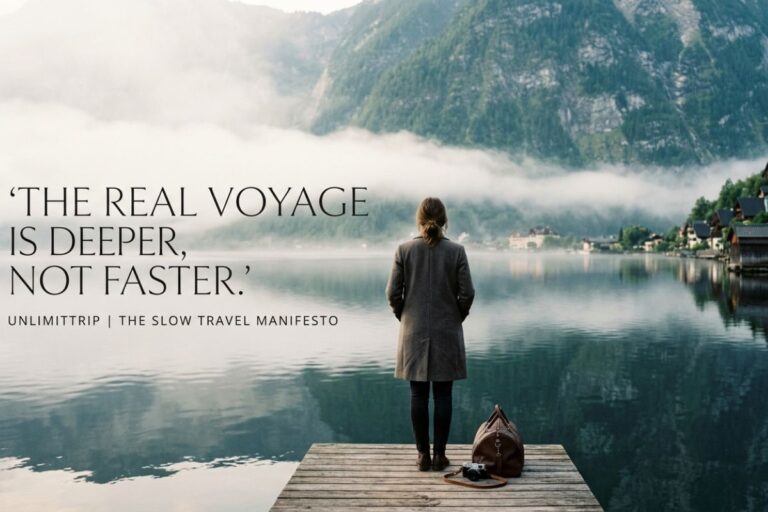
4. Travel Slower, Not Further
Escape travel is about changing locations. Arrival travel is about deepening in one place.
You can’t meet a place in 48 hours. You definitely can’t meet yourself.
Stay longer. Move slower. Let the place—and yourself—reveal something real.
Why Most People Will Keep Escaping
Here’s the uncomfortable truth: Most people will keep traveling to escape.
Because escaping is easier.
Traveling as escape feels good immediately. You book the flight, you feel relief. You land somewhere new, you feel hopeful.
Traveling as arrival? That can feel terrible at first.
When you stop using travel to run away, you have to face what you’ve been running from.
When you stop filling every moment with sightseeing, you have to sit with boredom. With loneliness. With whatever feeling your routine usually numbs.
When you travel with intention instead of just “getting away,” you have to be honest about what’s actually wrong in your life.
That honesty is painful.
But it’s also the only thing that works.
The discomfort is the point. The mirror is supposed to show you things you don’t usually see.
And once you’ve seen them—really seen them—you can’t unsee them. Which means you can finally change them.
Travel Is Not Escape—It’s the Beginning
Remember that beach in Thailand? The one where I felt nothing?
I went back there three years later. Same beach. Same sunset. Completely different experience.
Because I wasn’t running anymore. I wasn’t escaping. I was arriving.
I’d stopped asking the destination to fix my life. I’d started asking myself what needed to change.
And that shift—that simple, brutal shift—changed everything.
Travel didn’t become less important. It became more important. Because it stopped being a drug and started being a practice.
So the next time you feel the urge to book a flight, pause.
Ask yourself: Am I running away from something, or am I moving toward something?
One is escape. The other is arrival.
And only one of them will actually change your life.
Travel is not escape. It’s the beginning of everything.
Ready to travel with intention instead of escape? Follow us on Pinterest for weekly reflections on contemplative travel and the art of arriving.


One Comment